Instructions
How to use PNA Audit
One engagement, start to finish: the download, the security warnings that stop most people on their first attempt, the key, the first client file, and the signed report at the end of it. Read it through once, or jump straight to the bit currently on your screen.
Contents
What this program is, and is not
Think of PNA Audit as a filing cabinet with the audit already printed inside it. One Windows program, one encrypted file per client: the checklists, the working papers, the trial balance and the drawn statements, the materiality workings, the misstatement schedule, the engagement and representation letters, and the audit report itself, all in the one file, all on your own disk. There is no server behind it and nothing to log into. Close the laptop and the whole engagement travels with you.
What you need
- Windows 10 or 11, 64-bit. That is where the office works. For a Mac, an iPad or a client's desk there is the browser edition of the same program, which opens and saves the same files.
- About 200 MB of free disk space. The program itself is one file; the rest is working room.
- An internet connection, once, to activate. After that the program never needs one. If even that first connection is a problem, see activating with no internet.
- Your product key, in the form
PNA-XXXXX-XXXXX-XXXXX. It comes from the key desk, and it can always be recovered from My licence.
Two firm rules worth knowing on day one
- Save client files in the firm's OneDrive folder, not on the local disk. That single decision is the off-site copy, the version history and the recycle bin at once. Why.
- Nothing about a client ever leaves your computer. Activation sends the key and a code identifying the machine — never a name, a figure or a file. This site could not leak an engagement if it tried.
What it deliberately does not do
- It does not upload anything, to this site or anywhere else.
- It is not an accounting package. The trial balance comes in from the client's Excel or Tally export on the FINANCIALS tab, and everything after that — grouping, statements, figures — is the program's job.
- It does not file returns. It prepares the working papers, the Form 3CD / Form No. 26 content and the report; you file them wherever the firm files them today.
Get your product key
Fill in the short form on the home page with your firm email address. A six-digit code arrives by email; type it in and the key is on your screen immediately, and in your inbox as well.
- The address must end in
@painayak.com— that gate is what keeps the site internal. Anyone else needs a partner to issue a key by hand from the admin panel. - One key per person. A second machine goes on the same key; if the form says your address already has one, sign in under My licence and it is right there.
- If the key goes missing later, the same code-by-email trick brings it back — that is the whole of My licence.
Download the program
There is no installer, no setup wizard and no next-next-finish. One file lands in your Downloads folder, and that file is PNA Audit — which is why the next instruction matters more than it looks.
- Press Download for Windows on the home page. The version and build date are shown beside the button.
- When the browser finishes, move the file out of your Downloads folder,
into
Documentsor a folder of its own. Clearing out Downloads would delete the program itself. - Right-click it and choose Pin to Start, or Show more options ▸ Send to ▸ Desktop (create shortcut), so you can find it tomorrow.
Windows does not know us yet
This is the step that generates most of the desk-to-desk calls, so it is worth a minute. Windows keeps a running count of how often it has seen a program before; ours is published by the firm, not by a software company with a paid reputation certificate, so Windows says what it always says about a program it does not recognise — in one of four wordings, each with its own button in its own place.
None of them means there is anything wrong with the file. Find the wording on your screen and follow that part.
"Windows protected your PC", SmartScreen
A blue box appears when you open the file, and the only button you can see says Don't run.
- Click More info, a small link inside the blue box, very easy to miss.
- The publisher line and a Run anyway button appear. Press it.
You will not be asked again for that copy of the file. Download it fresh and you get the prompt once more.
The file vanishes, or "Threat found", Microsoft Defender
Defender occasionally quarantines an unrecognised program on sight. The download disappears and a notification says a threat was found. To get it back:
- Open Windows Security: press the Windows key and type Windows Security.
- Go to Virus & threat protection ▸ Protection history.
- Find the entry naming PNA Audit, expand it, and choose Actions ▸ Allow on device (or Restore).
If it keeps happening, tell Defender to leave the folder alone: Virus & threat protection ▸ Manage settings ▸ Add or remove exclusions ▸ Add an exclusion ▸ Folder, and pick the folder you saved the program in.
"This app has been blocked", with no way past — Smart App Control
Smart App Control turns up on some newly installed Windows 11 machines. Unlike SmartScreen it offers no "run anyway": it refuses every program not signed by a recognised publisher, and that is the end of the conversation.
- Open Windows Security ▸ App & browser control.
- Click Smart App Control settings.
- Set it to Off and confirm.
- Open PNA Audit again. You may still get the ordinary SmartScreen prompt above — that one does have a Run anyway.
"Unauthorised changes blocked" when saving a file
That is Controlled folder access, which stops programs writing into Documents
or Desktop. Either save your .pna files somewhere else, or allow PNA Audit
through: Windows Security ▸ Virus & threat protection ▸
Manage ransomware protection ▸
Allow an app through Controlled folder access ▸
Add an allowed app.
Firm antivirus
If a managed machine refuses the file entirely, send the IT provider this section — restore from quarantine, then exclude the program's folder. The steps above are the same shape in every brand.
Activate this computer
Past the warnings, the program opens on the only screen it will ever ask you to fill in twice — once per computer, never again on that one.
- Type or paste the key exactly as issued —
PNA-XXXXX-XXXXX-XXXXX. Upper and lower case both work and the dashes appear as you type. - Click ACTIVATE.
- The window closes and PNA Audit opens. That is the only moment the program uses the internet. It sends your key and a code identifying the machine, and gets back a signed licence file stored beside itself.
From then on it starts straight into your work, online or not. It checks in quietly whenever it happens to have a connection — that is how an extension reaches every machine without anyone re-typing anything — but a check that fails never stops you working.
No internet on that machine at all? Use Activate offline… and follow the offline steps.
Create a client file
PNA Audit opens on the client register — every client file opened on this computer, most recent first. On day one there is exactly one thing to press.
+ NEW CLIENT FILE asks for the company's details. Only the name is required; the CIN and registered office are printed onto the working papers if entered.
Windows then asks where to save it. Save it inside the firm's OneDrive folder — backups explains why this one decision matters more than any other made here. You now have a client window: one file holds one company and all of its years.
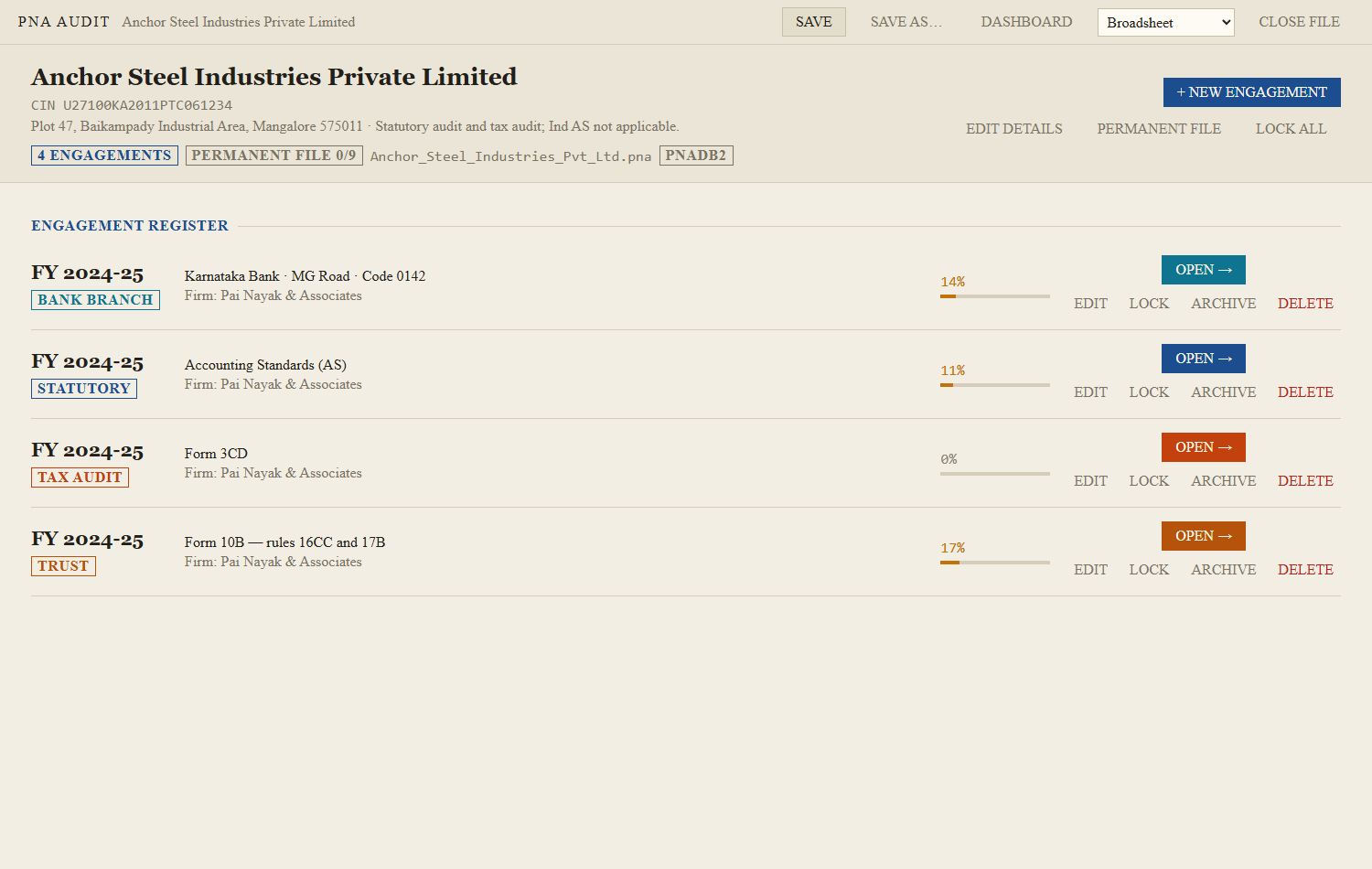
Add an engagement
An engagement is one year of one audit. + NEW ENGAGEMENT asks four questions, and between them they decide which tabs you get, which statutory lists you get, and how the report will read at the end:
- Type of audit. The six the program knows — and the client's entity type
decides which of them it may carry:
Type What it carries Statutory Audit The full Companies Act audit — SA 700 report, notes to accounts, Schedule III, IFC, CARO, Legal & Secretarial. Consolidation The group SA 700 and consolidation documents, alongside the standalone audits it consolidates. Tax Audit The clause-by-clause tax audit report — Form 3CD up to FY 2025-26, Form No. 26 (with its schedules) from FY 2026-27. No materiality: the form is a factual return. Statutory Audit Non-Corporate The SA 700 audit with the Companies Act machinery removed, for firms, LLPs, proprietors, HUFs, societies. Bank Branch Audit The branch auditor's report, LFAR, advances & IRAC, Memorandum of Changes, certificates, Ghosh & Jilani. Trust Audit Form 10B / 10BB with its annexure and the registration & compliance checklist. - Financial year. This decides which version of each statutory list you get; the versions in force are listed under the dropdown.
- Accounting standard. AS or Ind AS — it changes the notes checklist and the report's wording.
- Name of the auditing firm. Printed on the reports and letters. The firm's usual names are offered; type over them where an engagement needs another.
The dialog also offers to carry forward the prior year's setup when an earlier year of the same audit exists: process notes, the variance layout, letter wording and the standing registers come across; statuses, sign-offs and judgements deliberately do not.
Press OPEN → on the engagement row to start work.
Work through the tabs
The engagement window is a row of tabs arranged in the order an audit is actually done — planning on the left, fieldwork in the middle, completion on the right. Nothing is compulsory and nothing has to run in sequence. Work the way you work; the file keeps up.
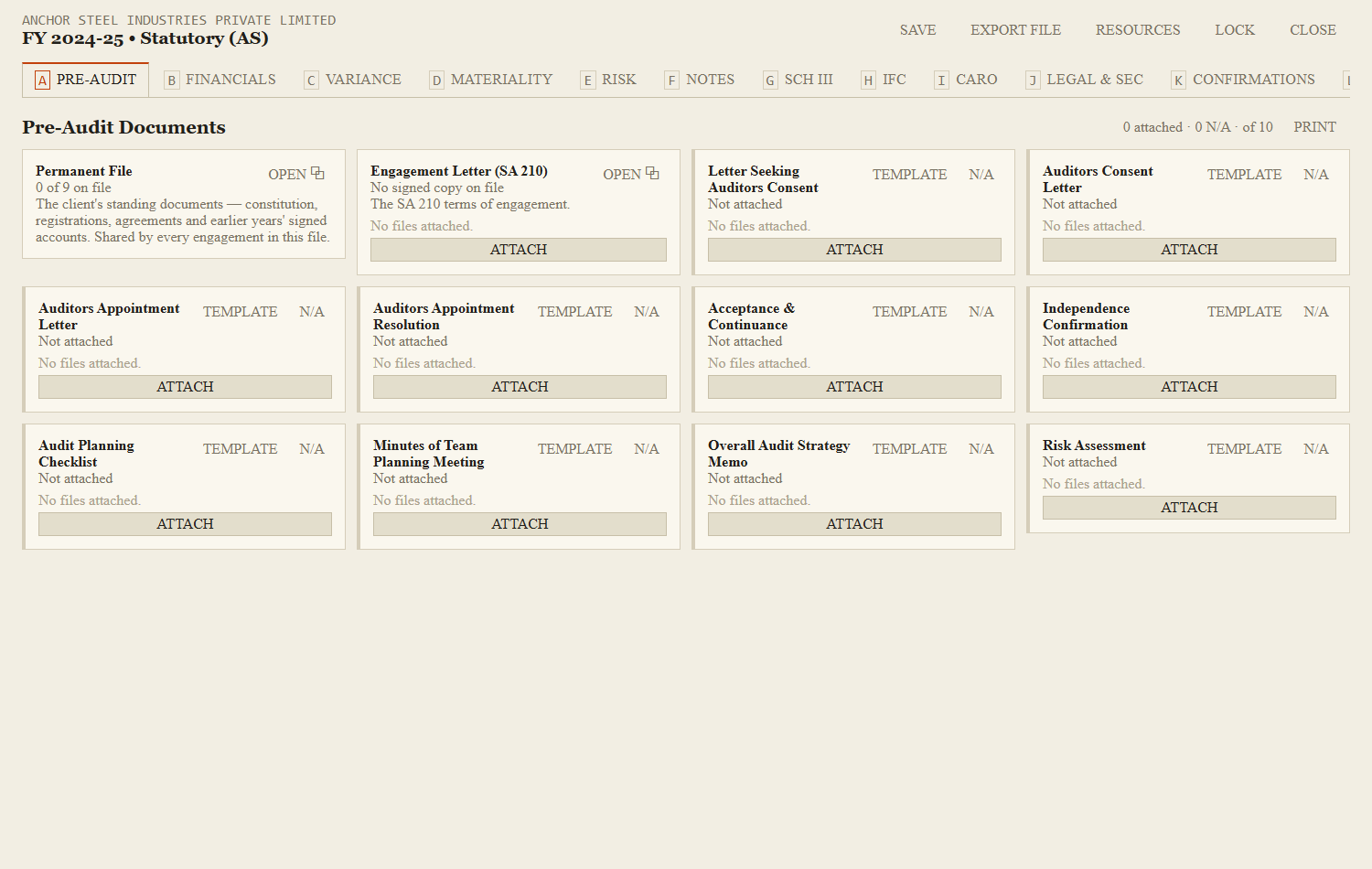
The tabs
A tab appears only where it applies to the engagement's type — a tax audit has no materiality, a bank branch has no CARO, and neither clutters anybody's screen.
| Tab | What lives there |
|---|---|
| PRE-AUDIT | The permanent file (documents shared by every engagement of this client), the engagement letter, and a template to print plus a place to file the signed copy for each pre-audit document — appointment, consent, independence, planning memos. |
| FINANCIALS | Three steps that turn the client's trial balance into drawn statements — see below. Also where the issued documents are filed once they exist, each with its signed copy. |
| CONSOL DOCS (consolidation) | The group working papers: consolidation adjustments and the supporting documents. |
| VARIANCE | Year-on-year comparison. Enter both years, and it computes every total and flags what moved; each flag becomes an open point with one click. Goes out to Excel and back — see below. |
| MATERIALITY | SA 320 — benchmark, percentages, overall and performance materiality, trivial threshold, with FILL FROM VARIANCE to take the three benchmarks off the variance tab. Everything else reads these figures; never recompute them by hand. A bank branch records the figure advised by the bank instead. |
| RISK | The SA 315 register: identified risks, assertion affected, response. |
| NOTES / TAX CLAUSES / BRANCH PROGRAMME / FORM 10B (the working papers, named by the engagement type) | One working paper per note, per Form 3CD / Form No. 26 clause, per branch programme step, or per Form 10B/10BB annexure item: the procedure already written out, your observations, attachments, status and preparer/reviewer stamps. |
| SCHEDULES (Form No. 26) | The tables particular clauses have to furnish, worked as real tables. Paste straight out of Excel; money columns total themselves. |
| SCH III / IFC / CARO / LEGAL & SEC | The compliance checklists. IFC answers drive Annexure B's opinion by themselves; CARO answers become Annexure A. |
| DEED (non-corporate) | Deed & constitution checklist for firms, LLPs and proprietorships. |
| ADVANCES / LFAR / CERTIFICATES / MOC / GHOSH & JILANI (bank branch) | The branch programme: IRAC classification with the suggested provision, the LFAR, the certificates, the Memorandum of Changes drawn from uncorrected misstatements, and the Ghosh & Jilani committee list. |
| REGISTRATION (trust) | Registration & compliance checklist for Form 10B / 10BB audits. |
| CONFIRMATIONS / RELATED PARTIES / COMPONENTS | The SA 505, 550 and 600 registers. |
| MISSTATEMENTS | The SA 450 schedule aggregating uncorrected misstatements against materiality. For a bank branch it doubles as the source of the Memorandum of Changes. |
| GOING CONCERN | The SA 570 assessment; its conclusion feeds the opinion suggestion. |
| MGT REP | The SA 580 representation letter — tick paragraphs, reword any, add your own, print. |
| OPEN POINTS / REVIEW | Every query raised anywhere, grouped by where; then preparer/reviewer sign-offs and LOCK once the report is signed. |
The financial statements, from the trial balance
The FINANCIALS tab carries the statements module in three steps on one page:
- Ingest the trial balance. Point it at the client's workbook — Tally exports, accountant formats and a blank template are all understood — and every ledger arrives with its closing balance.
- Group the ledgers. GROUPING WORKBOOK writes the whole trial balance to Excel with dropdowns of the schedule III lines; the article maps each ledger to its line and the workbook comes back in. Figures typed in Excel are refused — the place to adjust a figure is Out of Book Entries, so the statements can always be traced back to the trial balance.
- Draw the statements. Every figure in the emitted workbook is a formula, so an audit adjustment passed anywhere flows through the notes, the face, the cash flow and the ratios without a number being retyped. The MS sheet fills itself from the engagement's own particulars.
Where one year carries two engagements over the same statements — the statutory audit beside the tax audit, say — LINK FROM… copies the statements and trial balance across, so the two sets can never disagree.
How a checklist tab works
Learn one and you have learned all of them: the list down the left, the item you are working on to the right.
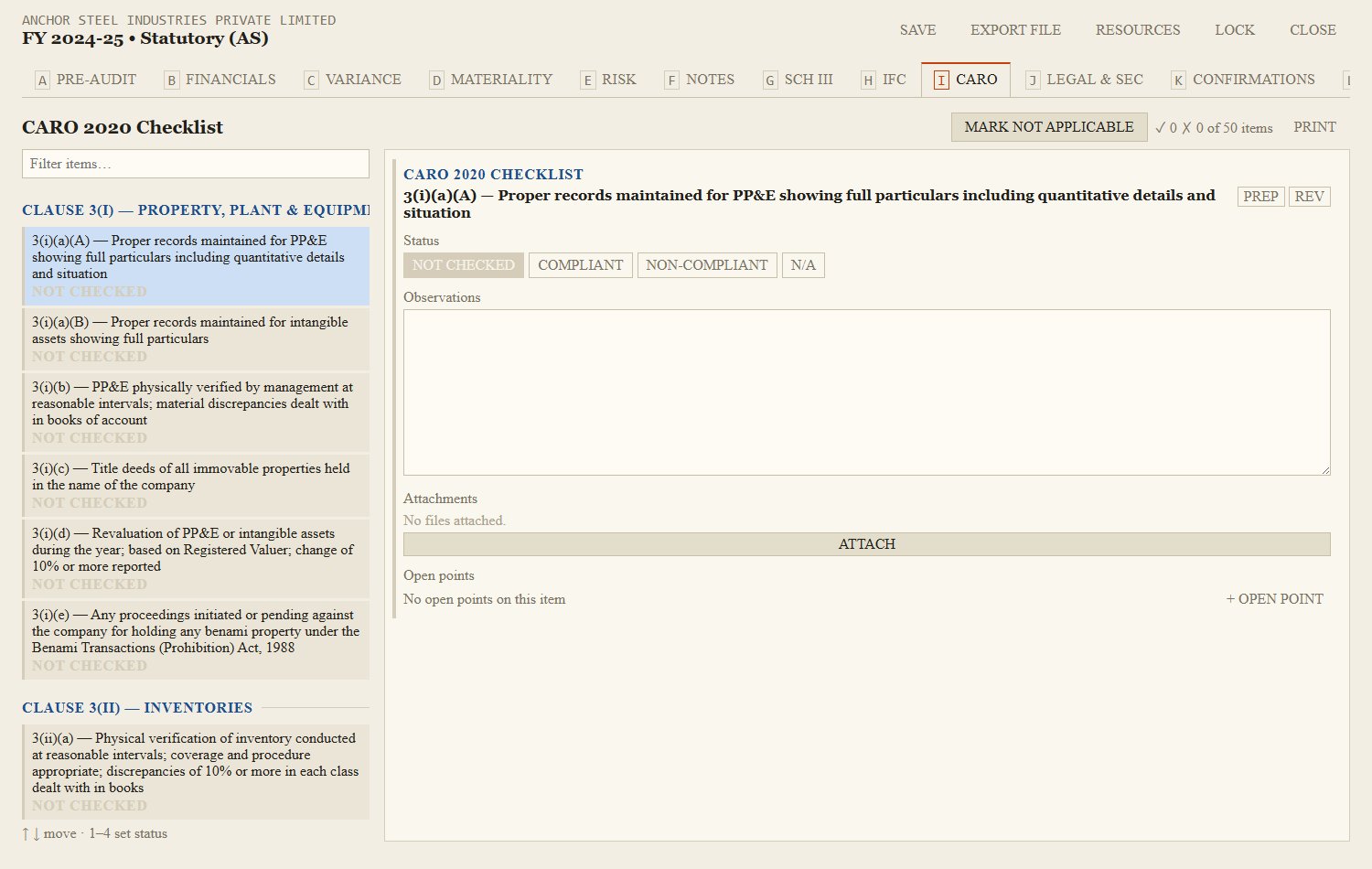
- Set status with the buttons or press 1–4; move with ↑/↓.
- Type what you found in Observations — that is the working paper; it prints and it is what a reviewer reads.
- ATTACH pulls a document inside the engagement file itself, so the original can be moved or deleted without breaking anything.
- The counter top-right feeds the engagement's progress percentage.
- MARK NOT APPLICABLE settles a whole section the clause does not reach.
Working papers
The notes tab is the same shape, with the audit procedure already written out for each note. Edit it where your approach differs, and record your observations underneath.
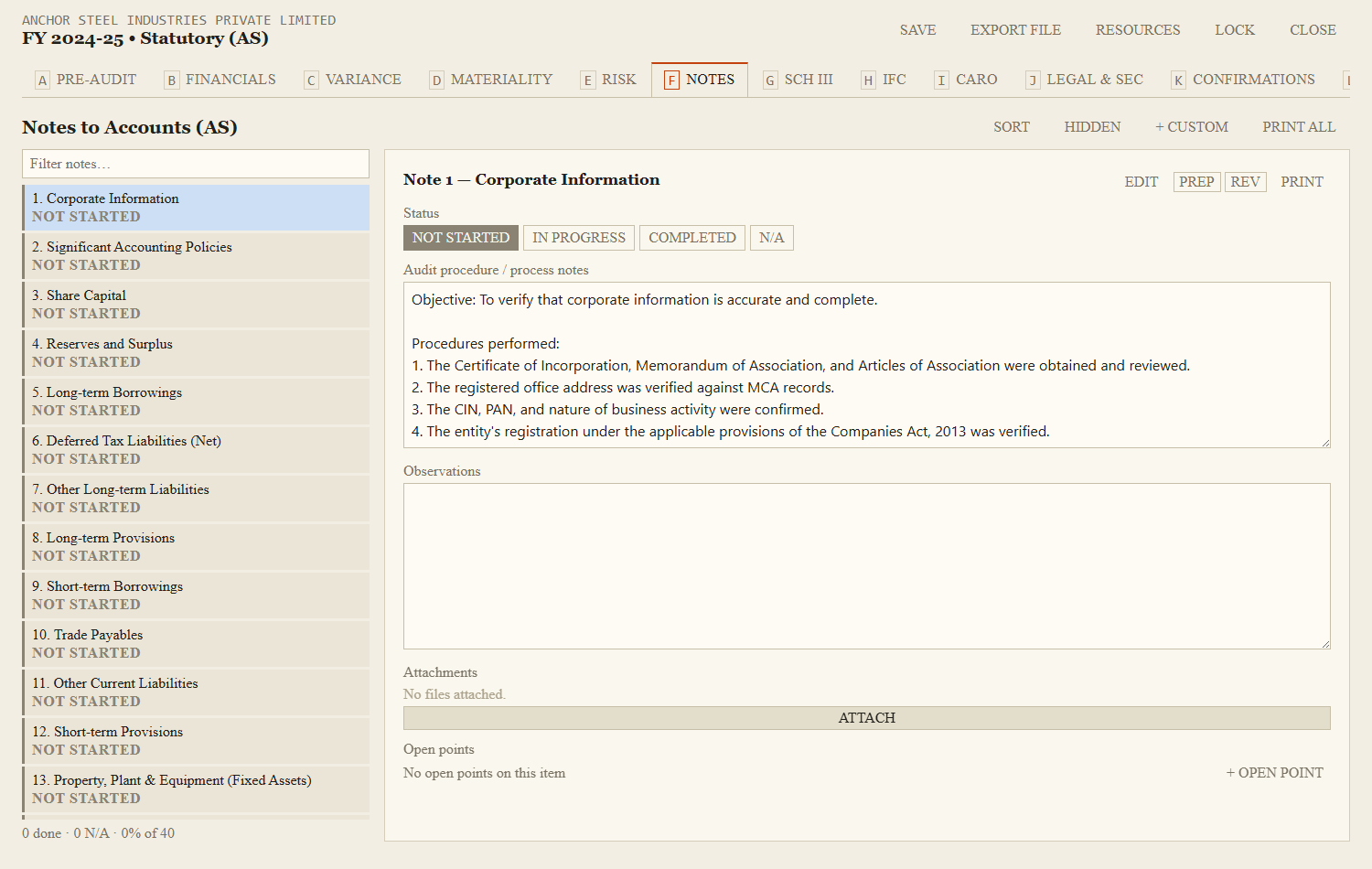
- HIDDEN shows the notes you marked N/A. Nothing is ever really deleted, so marking one N/A by mistake is always reversible.
- + CUSTOM adds a note the standard list does not have.
- SORT reorders them, and the printed numbering follows.
- PREP and REV stamp your initials as preparer and reviewer, with the date.
The variance tab goes to Excel and comes back
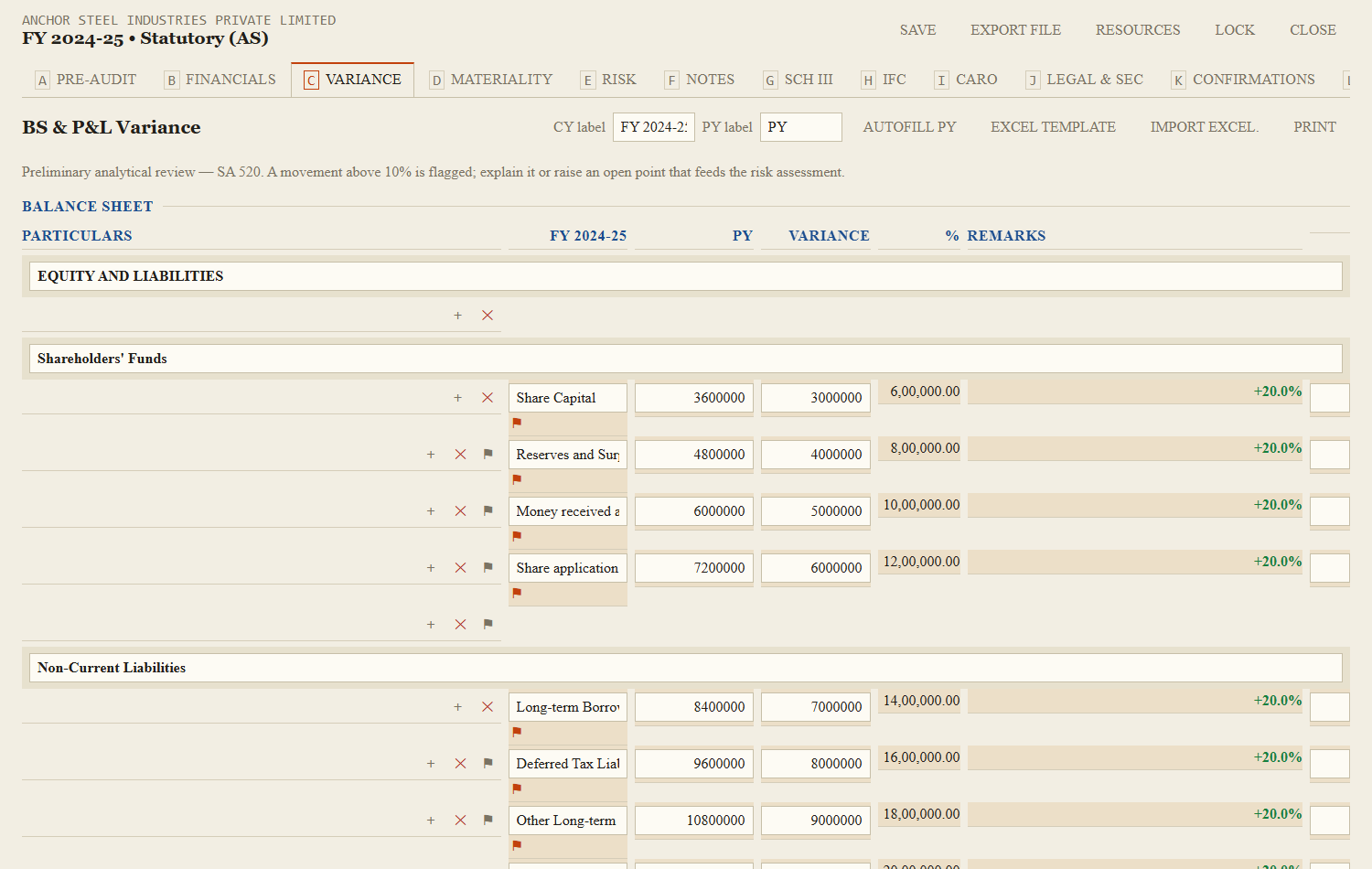
EXCEL TEMPLATE writes the whole tab as one sheet; IMPORT EXCEL… reads it back. Lines may be added, deleted, reordered and retyped in Excel — the import replaces the tab with what the sheet now says, so there is one rule to remember. Totals survive because each row carries an Id column; leave totals alone and they recompute.
Form No. 26 schedules
From FY 2026-27 the tax audit is Form No. 26, and thirty-nine of its fifty-three clauses furnish a table of their own — the ICDS adjustments, the depreciation blocks, loans under section 185, unquoted shares. The SCHEDULES tab lists every one with how much of each is filled in; the clause itself carries the same OPEN SCHEDULE button, so you can work either down the list or clause by clause. Paste straight out of Excel: copy a block of cells, click where it starts, Ctrl+V. Money columns total themselves, and where the Form prints its own total line no second total is added.
Three tables — 50(b), 50(c) and 52(a) — appear as a note rather than a grid, because their columns are not legible in the copy of the Form the clause list was written from. Take those from the notified Form.
Bank branch engagements
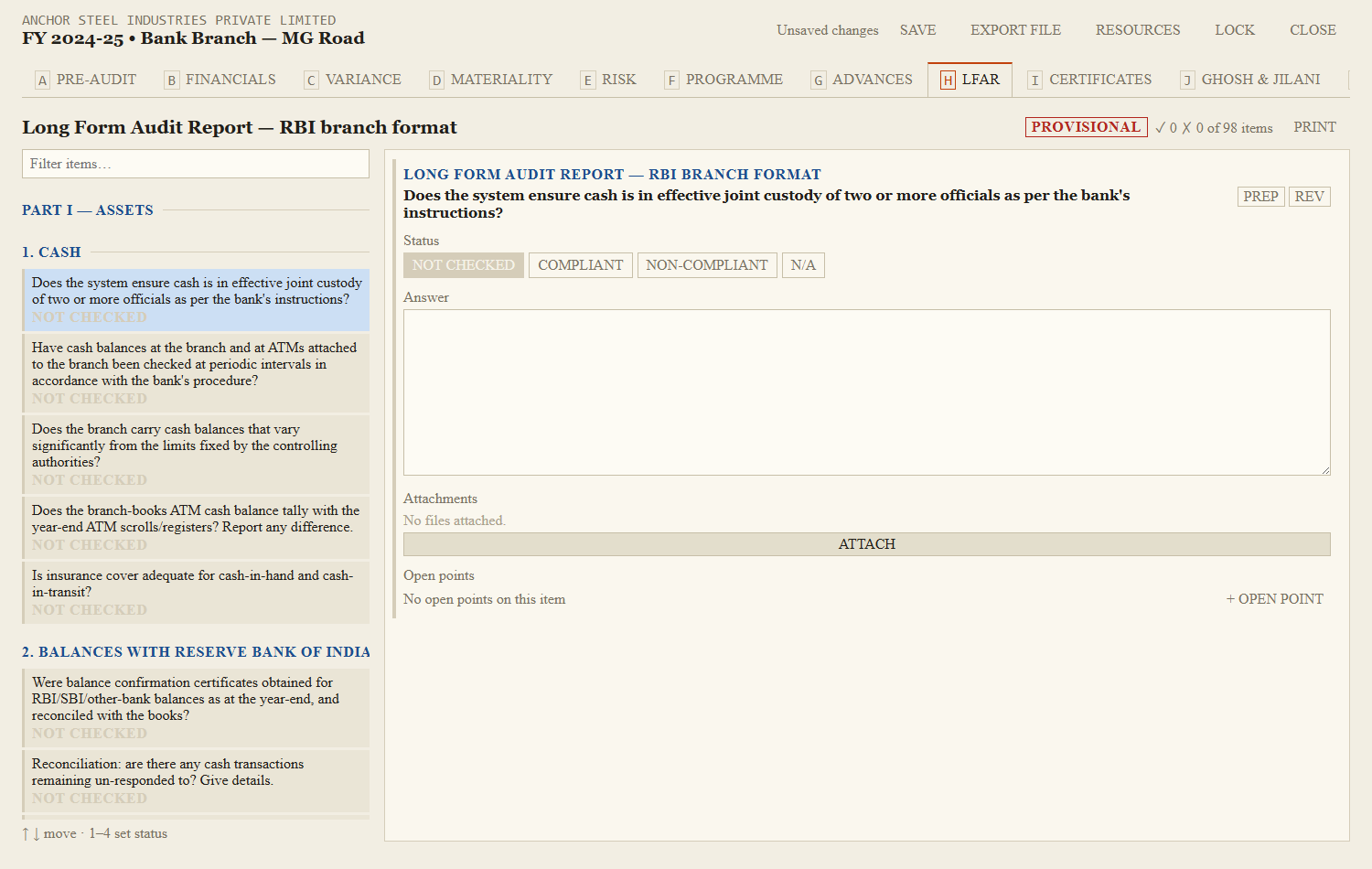
The branch programme is its own set of tabs: advances classified under IRAC with the suggested provision (marked provisional — the reported figure is the branch's), the LFAR, certificates, Ghosh & Jilani, and the Memorandum of Changes, which is assembled from the uncorrected misstatements the branch has not given effect to.
Materiality
Enter the current and prior year figures and the percentages you have chosen; the overall, performance and trivial figures follow. FILL FROM VARIANCE takes the three benchmarks off the variance tab as computed totals.
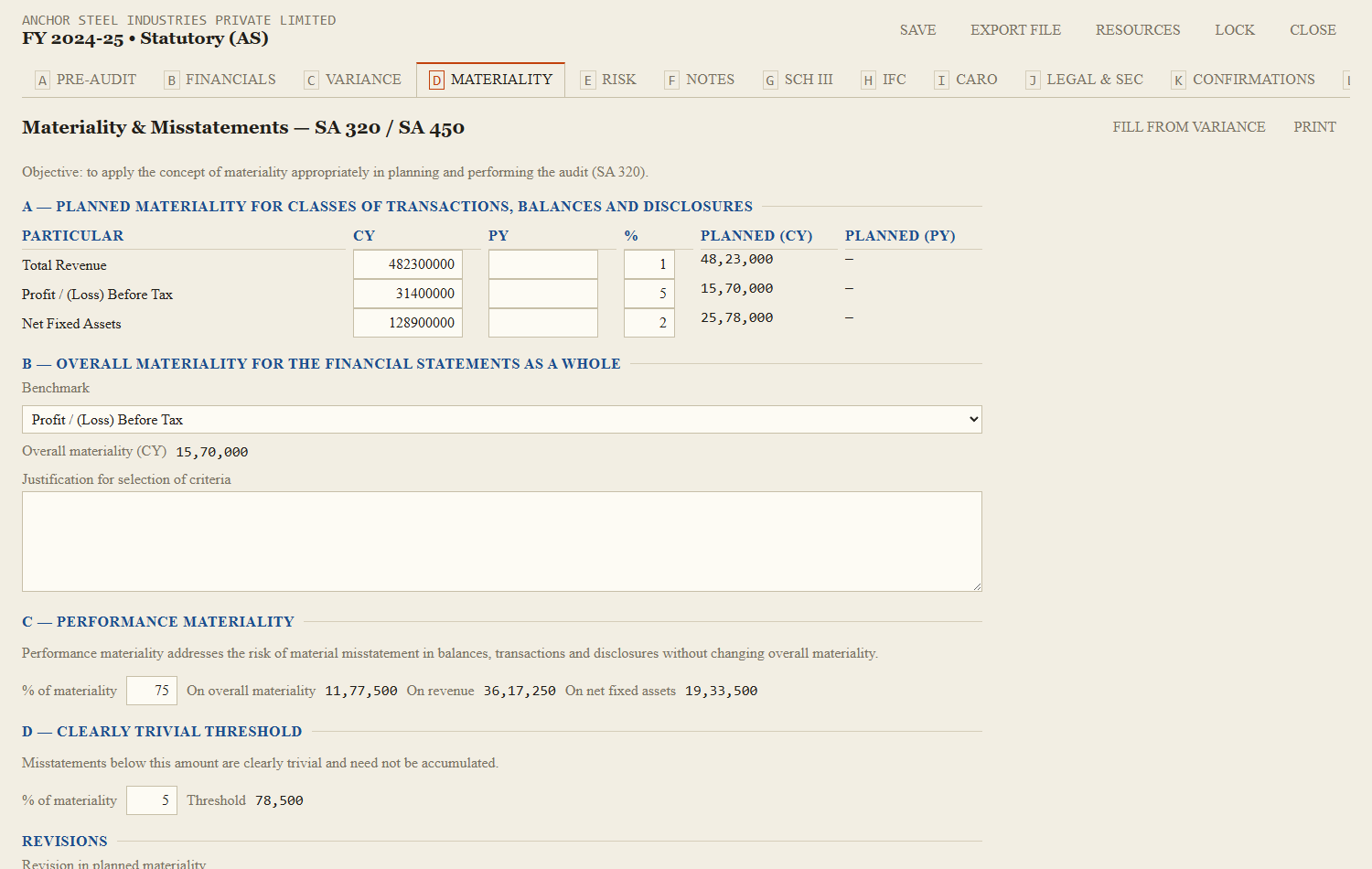
The misstatement schedule underneath aggregates uncorrected misstatements and compares the total against those figures, which is the SA 450 conclusion the file needs.
The reports are written, not assembled
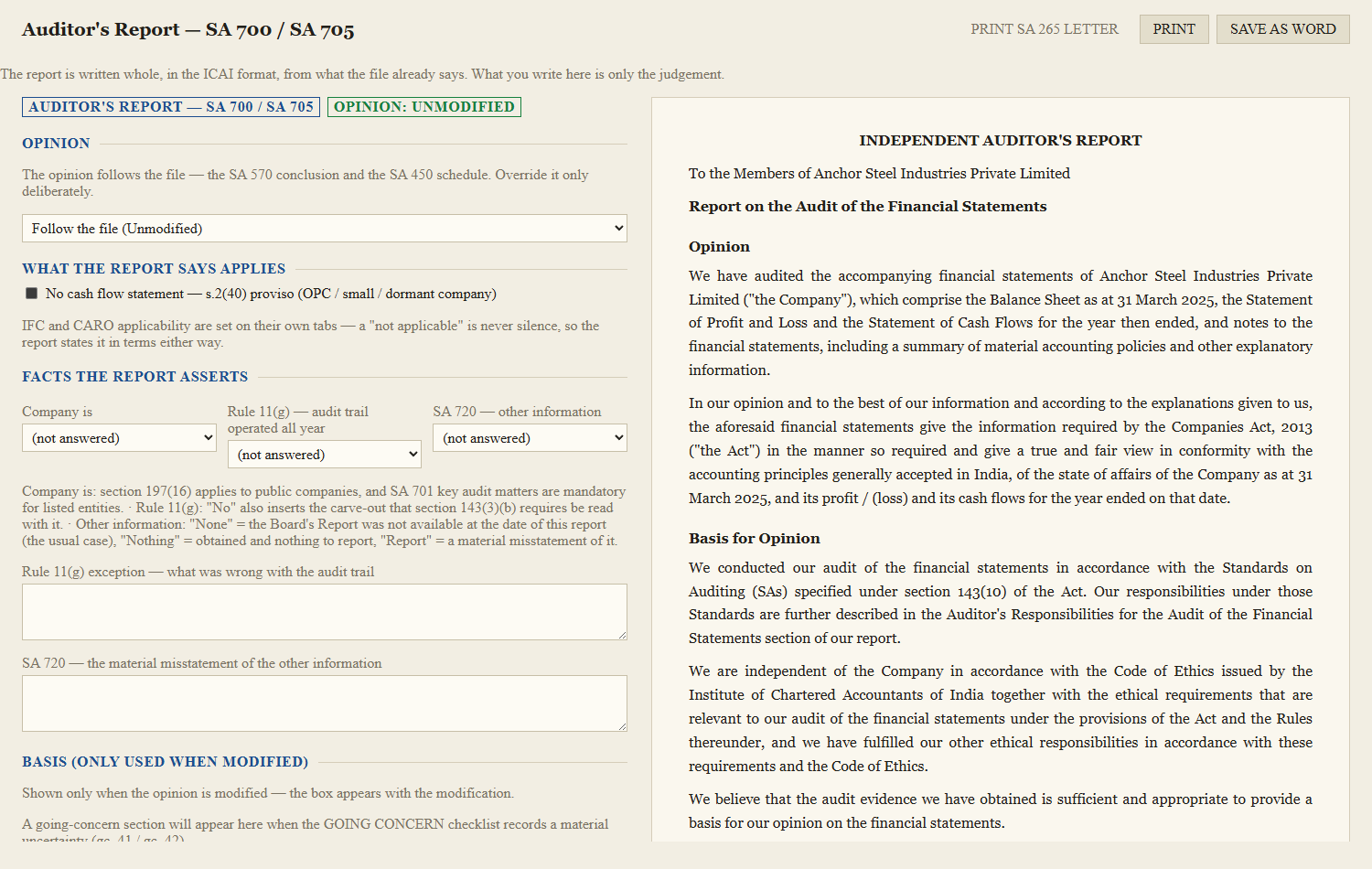
The audit report, both annexures, the representation letter and the engagement letter each open in their own window from the card on the tab where they belong: your inputs on the left, the finished document live on the right. The wording is generated from what the file already says — the IFC answers set the Annexure B opinion, the CARO answers become Annexure A, the going-concern checklist decides whether the SA 570 section appears. What the auditor writes is only the judgement: the basis of a modified opinion, the emphasis paragraphs, the key audit matters.
Saving
There is no save button. The file writes itself about a second after you stop typing and Saved ✓ appears top-right, so a flat battery costs a sentence, not an afternoon. Ctrl+S forces it if you want to see it happen before closing the lid.
Scrutinising the whole daybook
SA 240 paragraph 32(a)(i) says the auditor shall test the appropriateness of journal entries recorded in the general ledger. It is mandatory on every audit, and it is almost never done over the whole population, because by hand it cannot be. This does it over the whole population.
The reason it can is the FINANCIALS tab. Once the trial balance is grouped, every ledger in the file carries a Schedule III major head, a note line and a cash-flow tag — you have already told the program which ledger is rent, which is cash and which is a related party. That is the missing half of every generic “audit analytics” tool. It is what turns a ledger called RENT A/C - 2 (NEW) into an Other Expenses line, on the profit and loss, that should only ever be debited, and that attracts s.194-I — without anybody guessing from the name.
Giving it the daybook
TOOLS ▸ Ledger Scrutiny, inside an engagement. Drop the client’s voucher register on the window, or read one already filed against the engagement. Four kinds of export are read as they come:
- Tally Prime / ERP 9 — the Day Book export, title rows and all. Tally indents the second leg of a voucher and repeats neither the date nor the number on it; the blank date is the marker, and both are carried down. Tally keeps who entered a voucher and when in its Audit and Alteration reports rather than in the Day Book, so export one of those as well and use ADD THE AUDIT TRAIL — it is joined on voucher number, and it is what lets the Rule 11(g) tests run at all.
- SAP — an FBL3N / FAGLL03 line-item export or the document journal. SAP carries the entry date and the user natively, so the audit-trail tests run in full with no second file.
- Zoho Books, QuickBooks, Marg, Vyapar — the journal or transaction report each of them writes.
- The program’s own template — PUBLISH A BLANK DAYBOOK writes it, with the column meanings on a second sheet. Send it to the client before the audit starts, or key a small client’s book into it. It is also the answer when the ERP is not one of the other three.
You are never asked for the “other side” of an entry. A daybook is one row per leg, so the contra side is simply the other rows carrying the same voucher number — the program puts the voucher back together itself.
What it looks for
154 rules in nine families. A few of them, to show the shape:
- Does the book tie? Every ledger’s movement in the daybook against the trial balance’s own closing less opening. If it does not tie, the head-aware families are refused and the paper says so — a finding drawn from a book that is not the audited one is not a finding.
- The audit trail, Rule 11(g). Back-dated entries, vouchers altered after creation, entries created after the year end or after the report date, postings outside business hours, a login used five times all year. Your report already asserts that the client’s software preserved an audit trail; this is the evidence for it.
- Journals — SA 240. Straight to cash, to a bank, to revenue, to reserves or share capital. Round sums. No narration. Above performance materiality. Passed on 31 March. Reversed in the first fortnight of the new year.
- Postings the heads make visible. A debit head closing in credit. Depreciation credited. Cash on hand negative on some day in August. A trade receivable with a credit balance. Repairs above your capitalisation limit. Finance costs with no borrowing behind them.
- The Income-tax limits. s.40A(3) — and its aggregation limb, six payments of ₹9,000 to one party on one day, which is where the real disallowances are. s.269SS, s.269ST, s.269T. s.43B unpaid at the close. TDS deductible with no deduction in the voucher, the section chosen from the note line rather than from a name. Penalties, donations, personal expenditure, prior period.
- CARO 2020. Loans to related parties, default in repayment, short-term funds in long-term use, cash losses, CSR, managerial remuneration.
- Analytics — SA 520. Benford, round-sum concentration, duplicates, dormant ledgers that wake for one entry, the top five parties as a share of purchases, a March spike per head, and every entry above performance materiality listed out.
Every threshold is printed on the paper — the statutory ones with the section named, the risk-based ones taken from the SA 320 figures you set on MATERIALITY, the rest firm defaults you can change per run. A rule whose threshold the reader cannot see is a rule nobody can rely on in a peer review.
What comes out, and what it does not say
The page is a working paper: the control totals first, the findings under them, then numbered notes carrying every threshold in force and every rule that did not run, with the reason. “Found nothing” and “was not looked for” are different facts, and this paper never lets them read the same. No trail columns in the export and no audit-trail workbook? The audit-trail family is not run, and it says so — rather than reporting that it found nothing. Give it a trail that covers only part of the year and it prints how far it reached, because half the book examined is not the book examined.
KEEP IN THE FILE puts the run into the engagement and a SCRUTINY tab appears, where the exceptions sit with their dispositions and each finding can be written into the clause it answers — clause 21, 23, 26, 31, 34, the CARO clause, or the open points list where there is no clause for it. The observation is drafted; the status is never set, because whether a clause is complied with is your conclusion.
What is stored is the manifest, the exceptions and a per-ledger monthly summary — never the voucher lines, which would be 40 to 60 MB in a file that is meant to open in a second. The daybook’s SHA-256 is recorded, so a reviewer in year three can tell whether the workbook attached to the file is the one that was scrutinised. Re-read a corrected daybook and every exception you have already cleared keeps its disposition.
Choosing which items to test
SA 530 asks you to test a sample, and the whole value of the exercise is being able to say how the items were chosen — not that they were convenient. This picks the items, records how, and proves on the paper that the selection resembles the population it came from. It does not test anything, and nothing it produces is an audit conclusion; it is how the evidence for one was chosen.
Three ways of choosing, and the program says which it is using:
- Simple random — the plain case, and the one the comparison panel is the true scorecard for.
- Stratified — bands by amount, drawn by count, never by value: a value-proportional split over-draws the top band and makes the comparison worse than a plain random draw, and that is measured, not assumed.
- Monetary-unit — selects with probability proportional to value, so its mean sits above the population’s by design. What it buys is value coverage; negatives are left out and counted.
The panel is mean, median and standard deviation against the population’s, each checked against your tolerance, STDEVP — divisor N — on both sides exactly as the firm’s own sheet did it. All three inside and it goes green; for monetary-unit it stays grey, because there the panel is the wrong scorecard and the tool says so rather than putting three red marks on a correctly drawn sample.
Key items are examined in full, on the absolute amount, and taken out of the draw, so the comparison is sample against the residual population — the one it was actually drawn from.
KEEP IN THE FILE attaches the workbook and records the method, size, seed and a fingerprint of the population on the audit trail, so a reviewer in year three can tell what was drawn, from what, and check it not only reproduced.
Client PDFs, without a website
An audit file is made of PDFs the client sent, and they arrive in the wrong shape. Forty separate bank-statement pages that should be one document. A 90 MB phone scan of a lease that will not go into an email. A page filed upside down. A ledger locked inside a PDF that somebody is now re-keying into Excel by hand.
The usual answer to all four is a free conversion website — which means uploading the client’s financial records to a stranger’s server. Clause 1 of Part I of the Second Schedule to the Chartered Accountants Act makes disclosure of information acquired in the course of a professional engagement, without consent, professional misconduct. The PDF Workbench does the same nine jobs on this computer. Nothing is uploaded and no file leaves the machine.
- Merge — several PDFs into one, in the order you put them, with a page range per file if you only want part of each.
- Split — every page, every n pages, at chosen pages, or one range taken out.
- Compress — below.
- Rotate — every page drawn as a thumbnail that turns as you turn it, so you are looking at the document rather than at the word “upright” beside a page number.
- PDF to Word, Excel and PowerPoint, PDF to images and images to PDF. The three conversions are reconstructions, and the program prints what did not come across every single time.
Getting a file under a size
Nobody wants “Strong”. What you want is for the lease deed to go through a mail server that refuses anything over 10 MB. So compress opens on GET IT UNDER A SIZE — 25 MB, 10 MB, 5 MB, 2 MB, or any figure you type — and the program does the searching. It tries the gentlest setting first and stops at the one that fits, so a file is never squeezed harder than the size you asked for.
A page that carries text keeps its text, whatever the target. Flattening the text off a page is a separate box you have to find and tick, and it warns you first.
Why a file will not compress, said before you wait for it
Choose a file and the page draws a bar of what its weight actually is — pictures, the text and how it is laid out, embedded fonts, structure — with a sentence saying what that means. Only two things can be made smaller: a picture, and a page that carries no text at all (which is already a picture of words, so rebuilding it as one loses nothing). A file that is 84% text cannot come down, and the program says so before you spend twenty seconds finding out. The same figures are printed under every result, so a small saving reads as a fact about the document rather than a program that has failed.
Measured on the ICAI’s own tax-audit library, asked to get everything under 5 MB: the 2023 and 2025 guidance notes came down from 6.8 MB to 3.7 MB; the Form 3CD / 3CEB implementation guide from 7.9 MB to 2.3 MB; a 12-page 300-DPI scan from 12.8 MB to 287 KB, a 97.7% saving. Every one of them keeps every letter of text it had. The 2026 guidance note — 9.4 MB of almost nothing but text — reached 8.5 MB and said it could not do better, which is the honest answer for a file of that shape.
TOOLS ▸ PDF Workbench, from the home screen, the client screen or inside an engagement. Drop the files anywhere on the page, or choose them. Inside an engagement it lists the PDFs already attached to it, so you are not sent to find on a disk the file you filed last week, and it can put the result straight back on the engagement. Every attached PDF row carries its own PDF ▾ menu.
Open points, sign-offs and review
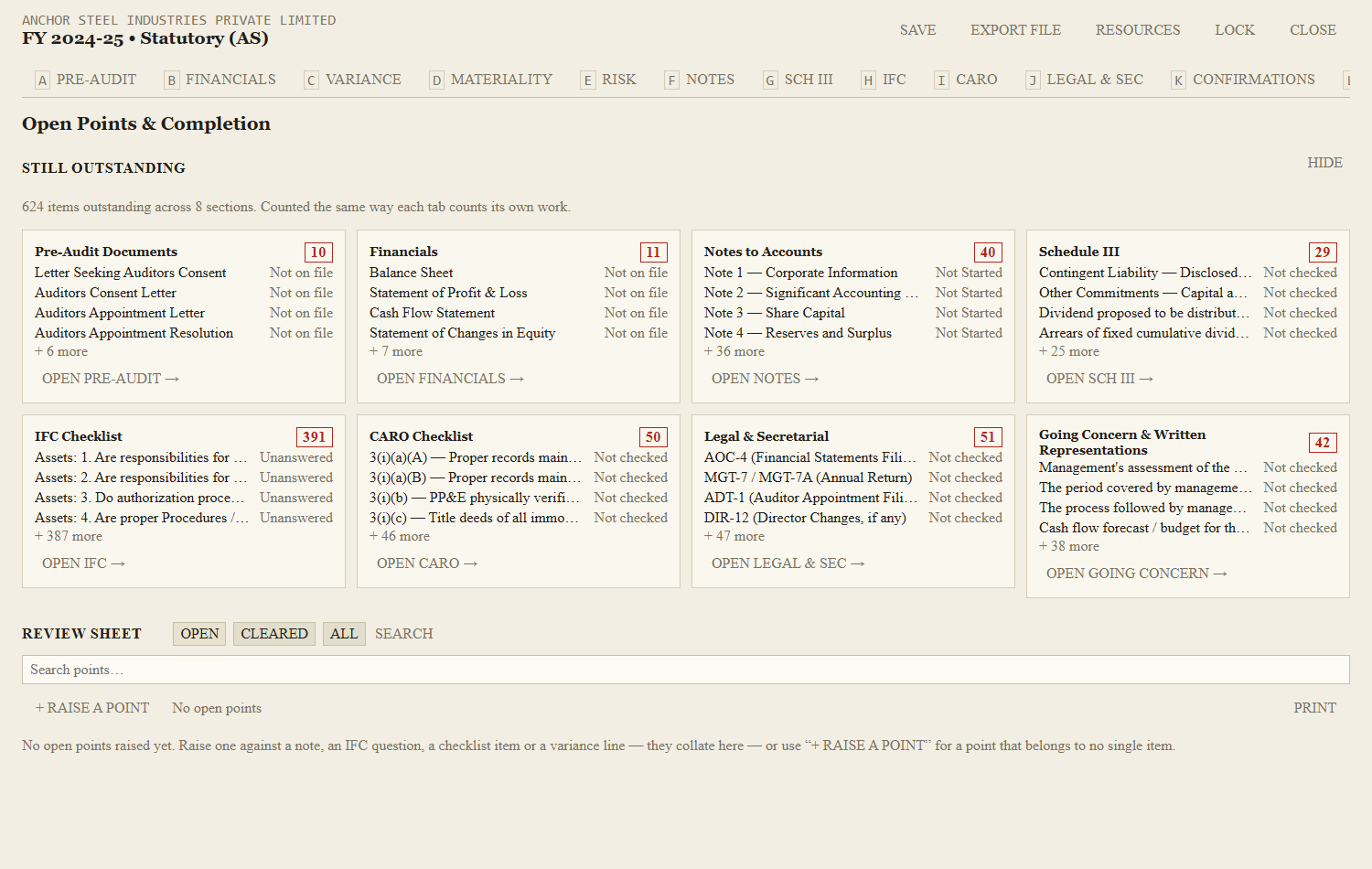
Everyone keeps a list of things to ask the client, usually on paper that goes missing. Here, wherever you are working — a note, a CARO item, an IFC question, a variance row — there is a ⚑ button that raises the open point right there. Raise it where you found it, while you still remember which figure prompted it.
The OPEN POINTS tab gathers all of them, grouped by where they were raised. Closing one there closes it everywhere, because it is the same point and not a copy. That list is the one to take to the client meeting.
REVIEW shows preparer and reviewer stamps across the engagement and what is still unsigned.
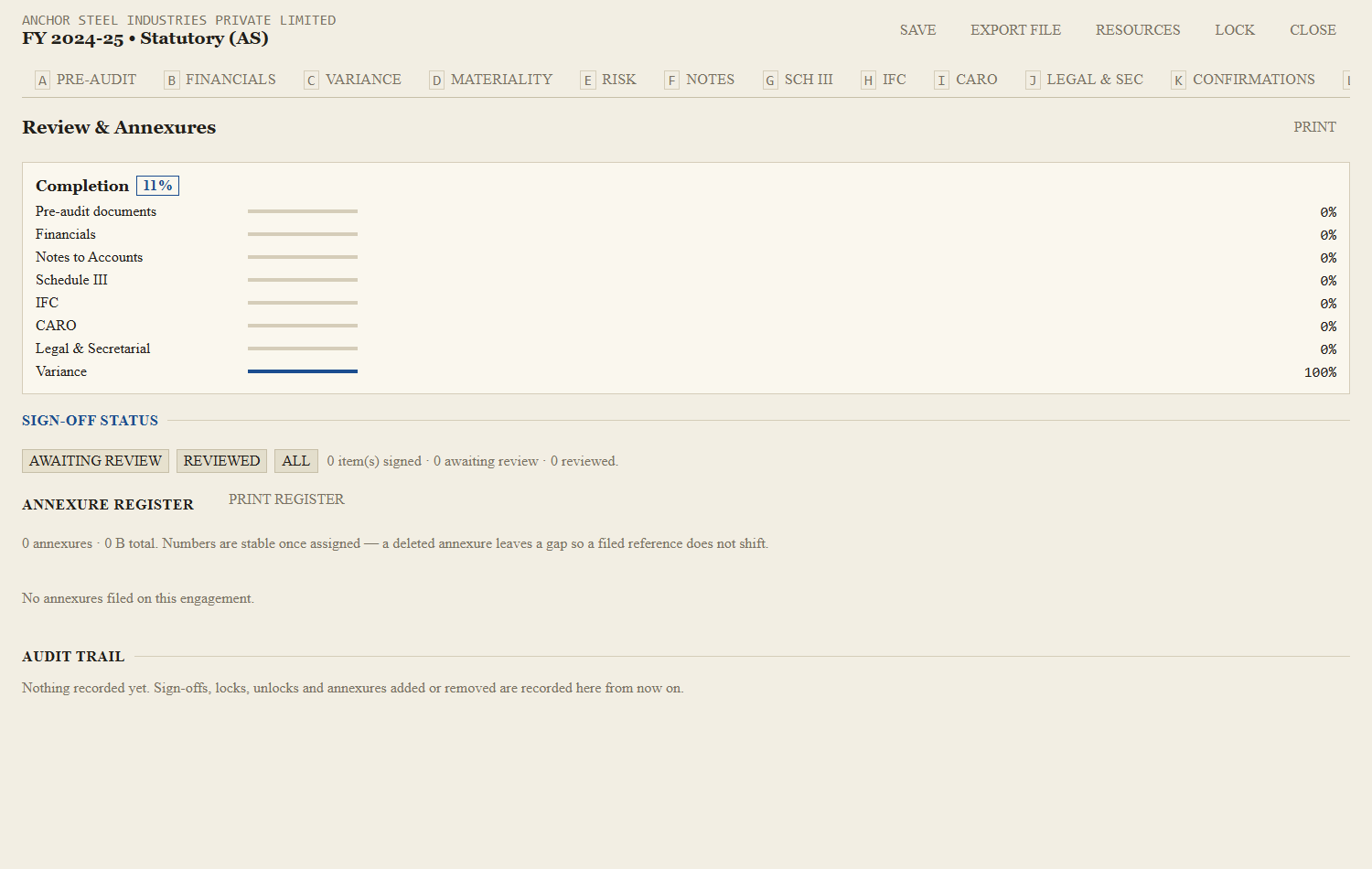
LOCK freezes a finished file so a signed engagement cannot be edited by accident. A locked engagement stays fully readable — only the editing stops.
Printing and exporting
- PRINT on any tab or document window prints just that — one checklist, one note, the representation letter, the audit report.
- PRINT ALL on the workpapers tab prints the full set of working papers.
- SAVE AS WORD sits beside every PRINT on a document, fed by the same view, so the .docx and the paper can never disagree. A report window's SAVE AS WORD emits the report and the SA 265 letter together.
- EXPORT FILE in the engagement header produces the whole engagement as one document — the file to hand a reviewer, or to keep as the permanent record.
- Pick Microsoft Print to PDF in the Windows print dialog for a PDF instead of paper.
FIRM DASHBOARD on the home screen points at a folder of client files and shows every engagement at once — progress, open points, uncorrected misstatements and the next statutory due date. It only reads; it never changes a file.
Reminding clients of their due dates
The firm keeps typing the same reminder mail, and clients keep missing the same dates. TOOLS ▸ Mail Reminders holds your own client list, works out from each client's entity type and registrations what falls due and when, and sends the mail from your own mailbox. It is a mail merge over a due-date calendar, and nothing more: it does not read mail, it does not know what any client owes, and it never says a client has defaulted.
- CLIENTS is the register. Name, entity type, State, which registrations the client actually holds (TDS, PF, ESI, professional tax, GST) and as many contact addresses as it has. A reminder is never sent for a registration that is not ticked, so an entity with no employees is never asked about provident fund. Import the list from an Excel sheet you already keep; the import merges on client name and never wipes.
- MAIL ACCOUNT… takes any mailbox that will give you an app password, Gmail included: host, port, TLS, address, password. The password is sealed with Windows' own protection on that PC and is never written to the shared folder. Send yourself a test before the first real run.
- DESPATCH is the day's work, and it leads with what is not going out: a client with no address on file, a mail the server refused, the days nobody opened the app. A client who was never reminded and never mentioned is the one failure this tool cannot afford.
- Every mail is held about fifteen minutes before it goes, so a wrong address or a wrong list can be stopped. Cancelling is recorded just as sending is.
- SENT LOG keeps every mail for good, the exact text, who it went to, and the outcome. That is the answer to "was the client told?", which is the question asked six months later.
Nothing runs while the program is closed. The check runs when you open the tool and every half hour the program is open. If nobody opens it for a week, that week's reminders go late — and where the due date itself has passed, the tool does not send at all, and says so on the page rather than passing over it in silence.
Reminders go out a few days before the date, once, and there is no chase afterwards. The program cannot know whether a client paid, and a mail saying "you have not paid" that is wrong even once costs more than every reminder it ever sent.
Backups, and why OneDrive
Audit files are the ones a firm is least able to reconstruct — a year's working papers exist in exactly one place and nowhere else. Two minutes now is the cheapest insurance in the program. The contents are unreadable to the sync provider; it is storing ciphertext.
For the shared library the program does it the other way round: set a backup folder inside OneDrive in NETWORK SHARING, and the PC keeping the files drops a finished copy of every client file there each time it closes. Files still open are skipped until they close; unchanged files are not copied twice; nothing is ever deleted from the backup. Do not open files from the backup folder — work from the library on the home screen.
The program also writes a timestamped .bak copy the first time it upgrades a file
from an older format, so an upgrade can always be undone.
The browser edition
The same program also runs as a web page, at justaudit.painayak.com/web/.
It opens the same .pna files, gives you the same tabs, and saves the file back —
decryption, editing and re-encrypting all happen on the device, and nothing is uploaded
anywhere. It is the thing to reach for on a Mac, an iPad, a Chromebook, or a client's desk
where nothing may be installed.
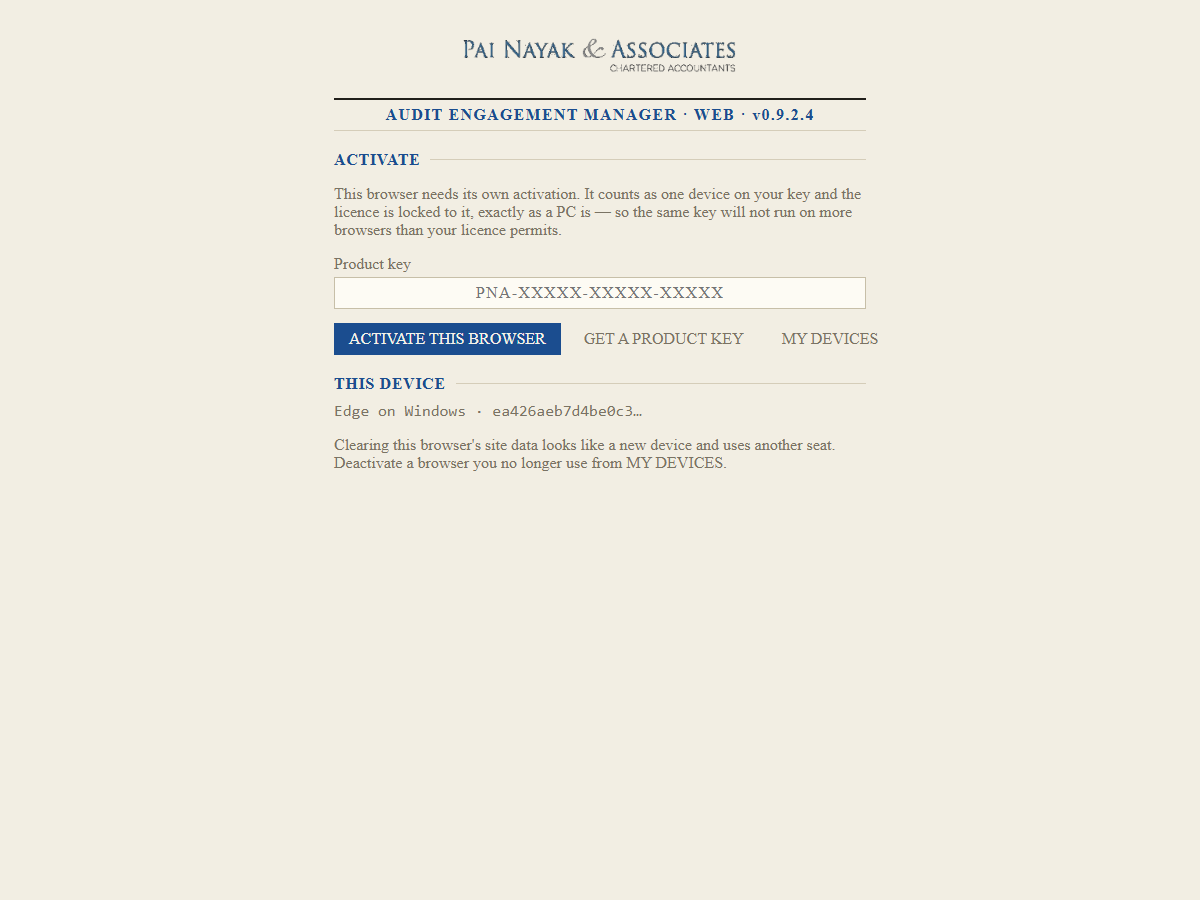
- A file worked on in the browser opens unchanged in the Windows program, and the other way round.
- Activating a browser consumes one of the key's device seats. Release an old browser from My licence when you stop using it — and do not clear the browser's site data, which reads as a new device.
- Windows remains the better desk for the heavy work: printing, Word export and the shared office library belong to the program.
More computers, or a replaced laptop
A key covers a fixed number of computers (2 to start). To add one: deactivate a machine you no longer use, then enter the same key on the new one.
- Sign in at My licence with your firm email.
- Find the old computer under your key and click Deactivate. The seat frees immediately.
- Activate the new computer with the same key.
Copying an activated computer's files to a second PC does not work. The licence names the machine it was issued to, and entering the key again is what uses a seat.
Your client files are nothing to do with the licence — just files. Copy them across, or if they were in OneDrive they are already there. Need more seats? A partner raises the number in the admin panel and nothing needs re-entering anywhere.
Activating a computer with no internet
Some machines — the ones with client data on them — are deliberately kept off the internet. Those can still be activated, by hand, in five steps and one email to a partner:
- On that computer, click Activate offline… on the activation window.
- At the bottom of that window is the device ID, a long code. Send it to the partner with your product key. It is not secret.
- The partner mints a licence block in the admin panel and sends back the text.
- Save it as a file named
license.datin the same folder as the program — check Windows has not called itlicense.dat.txt(turn on File name extensions in Explorer's View menu). - Open PNA Audit again. It starts straight into your work, permanently offline.
That licence is identical to one issued online, tied to that computer in exactly the same way.
When it goes wrong
Almost every problem anyone has had is in this table, in the words the screen used. Find your row.
| What you see | What to do |
|---|---|
| "Windows protected your PC" | More info ▸ Run anyway. Details. |
| The downloaded file vanished | Defender quarantined it. Restore from Protection history and add a folder exclusion, step 3. |
| Blocked, with no "run anyway" | Smart App Control. Turn it off in Windows Security, or ask a partner for an offline licence. |
| "That key was not recognised" | Look for a typo — a key never contains I, O, 0 or 1. Copy it fresh from My licence. |
| "This licence belongs to a different computer" | The licence file was copied from another PC. Delete license.dat beside the
program and activate this computer with your key. |
| "All device seats are in use" | Sign in at My licence and deactivate a computer — or a browser — you no longer use, or ask a partner for more seats. |
| Activation times out or will not connect | The network is blocking it. Try a mobile hotspot once, or use offline activation. |
| Your licence has expired | It keeps working for 7 days, with a warning, so nobody is locked out mid-audit. After that the app opens read-only: everything can be looked at, nothing changed or printed. A partner extends the key and the app is itself again on its next launch — no work is ever lost. |
| "Could not save" when saving a client file | Controlled folder access, or a folder without write permission. Save into the firm's OneDrive folder, step 3. |
| The program will not start at all | A half-finished auto-update is the usual cause: download the file again from the home page and replace the old copy. Nothing on disk is affected. |
| A colleague's edits are not appearing | Both of you must be opening the file from the firm library, not local copies. Check the FIRM LIBRARY section on the home screen, sharing. |
| The date looks moved back / licence cannot be checked | The computer's clock was wound backwards. Set the date correctly and reopen; the licence checks itself again by itself. |
Still stuck? Note what the screen said, word for word, and ask. Every wording on this page is deliberate — it matches what the program actually displays so people can find their problem by searching it.